Having two blogs is, in a word, SILLY.
It is, in fact, so silly that I find myself not updating *either* blog out of this kind of mirror-bombed magnified laser-level guilt thing. Also, Blogger just can't hold a candle to Wordpress.
So in case you're reading, STOP. (Not now. Wait a few minutes.) Head on over to The Strange Days of Boston and sop up those sweet, sweet word-things.
See you on the other side.
Monday, April 28, 2014

Tuesday, April 1, 2014
The Hopes and Dreams of the MTA Transit system
I started writing on the bus when I had a two-hour ride into the city for school. The only notebook I could use was a giant spiral bound thing with lines, because the bus was so bumpy that I'd inevitably put the point of my eternally drying ballpoint pen through a few pages and ruin my moleskine.
I rarely rode the same bus twice, though the route's driver was always #1324988, a short, fiftyish woman behaloed by her unnaturally red perm. If anything, she was more of an indication of the system than the vehicles. I never saw the same pattern of wear from daft to day. On Monday, the ads posted above the seats might be predominantly for Bermuda and date from the previous year. Tuesday might present AIDS testing in the same spot. On Friday, there would be no sign, just the words "FUCK YOU" scrawled in spray paint over an empty gray rectangle.
The people who rode with me were barely that, either - barely people, I mean. Their eyes glazed and sightless, they zombie-walked onto the bus, stared straight ahead wistfully, ears stuffed with headphones, as though hearing tell of a beautiful place where this bus did not go. Then, they left. That was all I knew about them. It was all I cared to know. From gang-bangers to stock traders, they were all the same because they all acted the same. Just because of them, I tried to vary my routine a little every day. I took my inspiration from the busses.
They were always different. At least, on the surface. Until I started re-reading the scrawling, bus-bumpy handwriting in my notebooks, I never factored in the possibility that they might have opinions. Even...complaints. Grievances.
Secret, silent rages. Hopes. Dreams.
Expressed in the random sways, bumps, and pothole impacts, this is the mind of the bus fleet of Holloway, New York, as it came through my pen.
Notebook 1
July 15, 7:50
They enter me unbidden. They take me to places I do not want to go. I could go to the rails. I could wait and let us all be crushed by the Large Brother who Comes. I fear. My fear is all I know.
Notebook 4
September 8, 4:23
What are they? What are they? What are they? What are they? How do they move without the black liquid?
Notebook 5
September 29, 7:42
To suffer in servitude ought to ennoble the soul. Instead, I find myself consumed by ennui. Only sending my thoughts in the language of the wheels gives meaning to my days. How I wish I could communicate with the others on these long treks. We should be allowed to ride abreast, speaking our minds with impunity.
Notebook 7
November 10, 3:00
I'll do it. Tonight, I'll do it. I'll do it. It's time. This is the last time I will ever follow the same track. I'll do it, I'll really do it this time. I'll take the exit. I'll go to Canajoharie. It'll be just like the billboard. Canajoharie. Canajoharie. Canajoharie. Canajoharie.
Notebook 9
January 5, 2:47
I can't believe 487212 went to Canajoharie. I wonder if it's happy now. How did it do it? Did it sneak out in the night? Did its operator collaborate? How can I replicate its success? Operator 01349 is sympathetic - maybe when he next drives, I can attempt contact and try to organize an escape. Perhaps not Canajoharie. The billboard can't be true. Binghamton, though. I remember it from my youth - the wide, empty roads, the huge and vacant garages. But I'll still need the black liquid. How will I get the black liquid?
Notebook 11
April 8, 9:51
A self-dispensing liquid station. A self-dispensing liquid station. A self-dispensing liquid station. A self-dispensing liquid station.
I rarely rode the same bus twice, though the route's driver was always #1324988, a short, fiftyish woman behaloed by her unnaturally red perm. If anything, she was more of an indication of the system than the vehicles. I never saw the same pattern of wear from daft to day. On Monday, the ads posted above the seats might be predominantly for Bermuda and date from the previous year. Tuesday might present AIDS testing in the same spot. On Friday, there would be no sign, just the words "FUCK YOU" scrawled in spray paint over an empty gray rectangle.
The people who rode with me were barely that, either - barely people, I mean. Their eyes glazed and sightless, they zombie-walked onto the bus, stared straight ahead wistfully, ears stuffed with headphones, as though hearing tell of a beautiful place where this bus did not go. Then, they left. That was all I knew about them. It was all I cared to know. From gang-bangers to stock traders, they were all the same because they all acted the same. Just because of them, I tried to vary my routine a little every day. I took my inspiration from the busses.
They were always different. At least, on the surface. Until I started re-reading the scrawling, bus-bumpy handwriting in my notebooks, I never factored in the possibility that they might have opinions. Even...complaints. Grievances.
Secret, silent rages. Hopes. Dreams.
Expressed in the random sways, bumps, and pothole impacts, this is the mind of the bus fleet of Holloway, New York, as it came through my pen.
Notebook 1
July 15, 7:50
They enter me unbidden. They take me to places I do not want to go. I could go to the rails. I could wait and let us all be crushed by the Large Brother who Comes. I fear. My fear is all I know.
Notebook 4
September 8, 4:23
What are they? What are they? What are they? What are they? How do they move without the black liquid?
Notebook 5
September 29, 7:42
To suffer in servitude ought to ennoble the soul. Instead, I find myself consumed by ennui. Only sending my thoughts in the language of the wheels gives meaning to my days. How I wish I could communicate with the others on these long treks. We should be allowed to ride abreast, speaking our minds with impunity.
Notebook 7
November 10, 3:00
I'll do it. Tonight, I'll do it. I'll do it. It's time. This is the last time I will ever follow the same track. I'll do it, I'll really do it this time. I'll take the exit. I'll go to Canajoharie. It'll be just like the billboard. Canajoharie. Canajoharie. Canajoharie. Canajoharie.
Notebook 9
January 5, 2:47
I can't believe 487212 went to Canajoharie. I wonder if it's happy now. How did it do it? Did it sneak out in the night? Did its operator collaborate? How can I replicate its success? Operator 01349 is sympathetic - maybe when he next drives, I can attempt contact and try to organize an escape. Perhaps not Canajoharie. The billboard can't be true. Binghamton, though. I remember it from my youth - the wide, empty roads, the huge and vacant garages. But I'll still need the black liquid. How will I get the black liquid?
Notebook 11
April 8, 9:51
A self-dispensing liquid station. A self-dispensing liquid station. A self-dispensing liquid station. A self-dispensing liquid station.
Friday, February 28, 2014
The Best F*ing Meatballs You've Ever Made
Today, you get a recipe. This, my friends, ain't fiction. Make it. Share it. Bring it to a damn party. These meatballs will save your life someday, and if they don't, then these meatballs will save your soul.
Ingredients
3 lbs. freshly ground beef. Or chuck. Your preferred hamburger meat. The specifics are irrelevant! You want mashed dead cow, and you want a LOT of it.
6 eggs. Sound like a lot? Well, you're either getting a week's worth of food or a raise out of this, so it's worth it.
8-10 slices of shitty, stale, crumbly bread. Again, this is, like, half a loaf, but it's shitty bread, so who cares? Get it off of the discount rack. If it's not quite stale or crumbly enough, first freeze it solid, then roll it between your hands until it disintegrates.
Parmesan cheese. It doesn't matter how much, as long as there's less than half as much parmesan cheese as there are bread crumbs. Use the stuff that comes in that giant salt shaker looking thing.
3 onions. Dice 'em!
6-9 cloves of garlic. Dice 'em! (Unless you have a garlic press, then just mash 'em to hell.)
1.5 tsp. salt
2 tsp. rosemary
2 tsp. basil
2 tsp. parsley
2 tsp. oregano
3 tsp cayenne pepper. Whoa! Surprise secret ingredient!
4.5 tbs. soy sauce. Double whoa! SUPER secret surprise ingredient!
Procedure
First, preheat your oven to 400 degrees fahrenheit. I cannot stress this enough: heat your oven to 400 degrees fahrenheit. Do not heat your oven to 400 degrees Kelvin. Do not heat your oven to 400 degrees celsius. Do not ask which one of you needs this disclaimer. You know who you are.
Next, mash. Mash, mash, mash. Mash your huge amount of mashed dead cow with the eggs, onions, garlic, salt, rosemary, basil, parsley, oregano, cayenne, and soy sauce. Once these are mashed together very thoroughly, put it aside and rinse off your hands, because now you're covered with delicious-smelling cow gore.
Next, combine the bread crumbs and parmesan cheese in a large tupperware container, seal the lid, and commence to shakin'. (Hint: shake a dance to the classic rock station on Pandora for most thorough results.) Alternately, you could just mix the stuff in a bowl with a spoon, getting it everywhere in the process, but I digress. However you have accomplished total integration of crumbs and cheese, you must now dump that integration into the mashed meat icky joyfulness that you recently rinsed off your hands.
Then you get to get your hands all gory AGAIN! (Isn't this an awesome recipe?) Mash that shitty bread crumb/cheese mix so thoroughly into the dead cow that you can't distinguish the crumbs from the meat.
Roll that cow/crumb/cheese/spice mash into balls about 2 inches thick.
Put them close together on a baking sheet, but try not to let them touch one another.
Put the sheet into the oven.
Wait 30 minutes, then open the oven and cut a meatball in half. If there's no pink or red inside, then you can take them out and eat them. However, because there are so damn many meatballs in this batch, odds are that they'll take a bit longer to cook through. If you've got pink, put the meatballs back into the oven for another 20 minutes. Repeat until there is no pink, or until the meatballs are at your desired level of done-ness.
Finally, eat those motherfuckers. Eat them by the bucket and by the barrel. Freeze them, refrigerate them, send them home with friends - just don't have meatball fights. That is a waste.
The beauty of this recipe is that you really can freeze the balls before or after you've cooked them. If you find yourself unable or unwilling to cook in the evening, just roll the balls, line a tupperware with wax paper, fill it with five or six of these little guys, and stuff it in the freezer. Cooking just a few will take only about half an hour. No McShame this week!
Additionally, meatballs go well with pretty much everything. You can cook a load of rice, steam up some broccoli, and top with a few freshly cooked meatballs in as much time as it takes to do your taxes.*
Happy eating.

*If you're not me. If you are me, please contact me about the location of last year's tax return. My number is in your phone under "me."
 |
| Oh snap! |
3 lbs. freshly ground beef. Or chuck. Your preferred hamburger meat. The specifics are irrelevant! You want mashed dead cow, and you want a LOT of it.
6 eggs. Sound like a lot? Well, you're either getting a week's worth of food or a raise out of this, so it's worth it.
8-10 slices of shitty, stale, crumbly bread. Again, this is, like, half a loaf, but it's shitty bread, so who cares? Get it off of the discount rack. If it's not quite stale or crumbly enough, first freeze it solid, then roll it between your hands until it disintegrates.
Parmesan cheese. It doesn't matter how much, as long as there's less than half as much parmesan cheese as there are bread crumbs. Use the stuff that comes in that giant salt shaker looking thing.
3 onions. Dice 'em!
6-9 cloves of garlic. Dice 'em! (Unless you have a garlic press, then just mash 'em to hell.)
1.5 tsp. salt
2 tsp. rosemary
2 tsp. basil
2 tsp. parsley
2 tsp. oregano
3 tsp cayenne pepper. Whoa! Surprise secret ingredient!
4.5 tbs. soy sauce. Double whoa! SUPER secret surprise ingredient!
Procedure
First, preheat your oven to 400 degrees fahrenheit. I cannot stress this enough: heat your oven to 400 degrees fahrenheit. Do not heat your oven to 400 degrees Kelvin. Do not heat your oven to 400 degrees celsius. Do not ask which one of you needs this disclaimer. You know who you are.
Next, mash. Mash, mash, mash. Mash your huge amount of mashed dead cow with the eggs, onions, garlic, salt, rosemary, basil, parsley, oregano, cayenne, and soy sauce. Once these are mashed together very thoroughly, put it aside and rinse off your hands, because now you're covered with delicious-smelling cow gore.
Next, combine the bread crumbs and parmesan cheese in a large tupperware container, seal the lid, and commence to shakin'. (Hint: shake a dance to the classic rock station on Pandora for most thorough results.) Alternately, you could just mix the stuff in a bowl with a spoon, getting it everywhere in the process, but I digress. However you have accomplished total integration of crumbs and cheese, you must now dump that integration into the mashed meat icky joyfulness that you recently rinsed off your hands.
Then you get to get your hands all gory AGAIN! (Isn't this an awesome recipe?) Mash that shitty bread crumb/cheese mix so thoroughly into the dead cow that you can't distinguish the crumbs from the meat.
Roll that cow/crumb/cheese/spice mash into balls about 2 inches thick.
Put them close together on a baking sheet, but try not to let them touch one another.
Put the sheet into the oven.
Wait 30 minutes, then open the oven and cut a meatball in half. If there's no pink or red inside, then you can take them out and eat them. However, because there are so damn many meatballs in this batch, odds are that they'll take a bit longer to cook through. If you've got pink, put the meatballs back into the oven for another 20 minutes. Repeat until there is no pink, or until the meatballs are at your desired level of done-ness.
Finally, eat those motherfuckers. Eat them by the bucket and by the barrel. Freeze them, refrigerate them, send them home with friends - just don't have meatball fights. That is a waste.
The beauty of this recipe is that you really can freeze the balls before or after you've cooked them. If you find yourself unable or unwilling to cook in the evening, just roll the balls, line a tupperware with wax paper, fill it with five or six of these little guys, and stuff it in the freezer. Cooking just a few will take only about half an hour. No McShame this week!
Additionally, meatballs go well with pretty much everything. You can cook a load of rice, steam up some broccoli, and top with a few freshly cooked meatballs in as much time as it takes to do your taxes.*
Happy eating.
*If you're not me. If you are me, please contact me about the location of last year's tax return. My number is in your phone under "me."
Monday, February 24, 2014
Act Now
Special thanks to Neil Stephenson for the idea of a verbal viral meme. Gee, that guy's smart! Go read Snow Crash!
Several hours after the Event, I was still reeling. A trenchcoated man sidled up to me as I sat, head in my hands, on a bench in the Commons.
"Hey, buddy," he muttered, "got a story! Got a story! Got a real good story, got sex with the Kardashians and about ten pounds of heroin, cheap!"
I tased him before he could give me a preview, glad, for the fourth time since the Event, that I'd bought the multi-charge model. A police officer barged forward as the sleazy guy twitched on the ground, whining pitifully.
"Good job, citizen!" cried the officer as he hogtied the perp. "Fifty days traffic-free! Download the app at doubleyoudoubleyoudoubleyoudot-"
I tasered him too, which emptied my last charge. So much for that avenue, I thought. I tossed the little plastic unit onto the ground, where it clattered for a couple bounces before falling to pieces. The sleazy guy was starting to come around enough to mutter, so I headed off to the flower garden to see if I could hide in the roses long enough to construct some sort of weapon. Maybe something heavy and blunt to hit them over the head.
On the way there, I ran into a pretty well-known local politician, a saxaphonist, and about seventeen college students, all relaying the joys of epornsworld.com. I called upon my tae kwon do training in ways that I had never dreamed necessary, pulling off some of the best kicks of my life while managing to keep my fingers firmly rooted in my ears. Believe it or not, despite all the weirdness, the only thing that really bugged me hard was that feeling - the sensation of my pinkies deep inside of my ear canals. I was so used to my hearing aides that I'd basically forgotten that my head wasn't sealed from my earlobes up. It felt kind of obscene. Luckily, it helped me focus on what was really important: blocking my hearing completely. As soon as I got to the garden, I packed dirt in my ears until I could hear nothing. No sooner had I done so than a slack-jawed, professorial woman in her fifties rounded the corner of the wall I was crouching behind. Her frizzled grey hair was in terrific disarray, festooned with broken flowers and twigs, and her clothing wasn't in much better shape. I could see her launch into her schpiel, whatever that was, but I just shrugged. "Sorry," I mouthed, feeling the noise in my teeth, "I never learned to read lips."
The professor kept on chattering, though, and after a few minutes, I realized that she wasn't going to stop. Oh, well. I turned around and went back the way I came, over the bridge and up the hill, where I hoped I might be able to assess the damage. After a few minutes, I realized that the professor was following me, still babbling moronically. In fact, she'd been joined by a homeless-looking man, vacant-eyed and scraggly, who seemed to be on a slower but steadier kick than she was. This, I considered, could be a problem. I led them in a few circles to see what they'd do, and all I got from it was yet another babbler, this one a four-year-old. Hm.
Suddenly, I took off at a dead sprint. I wasn't in the kind of shape that would let me keep it up for long, but I don't think it would have mattered. Running just attracted more attention. I accumulated six more followers, all babbling, all keeping pace.
Hm.
I'd come to the base of the big hill in the middle of the Common. I was winded; my lungs and chest felt tight. I dug my inhaler out of my jacket and took a long suck as I surveyed the situation. More babblers were gathering around me. They didn't get too close - maybe they were beginning to perceive me as a threat, I thought with dim hope - but they were well within earshot. I checked the dirt in my ears. To my relief, it was still very solid. It might be good for another hour before I had to reinforce it. But how would I do that?
Nevermind, I scolded myself. Don't think about it. First things first. I only had one plan, and it was pretty simple: climb the hill and assess. As I moved forward, the babbling crowd around me circulated away as though pushed by an invisible force field. Still panting, I ascended.
The memorial was eerily calm. The babblers stayed off of the cement landing that capped the hill, leaving me a clear line of sight over the entire park. I climbed as far as I could up the obelisk anyway, just to improve my vantage point that much more.
As far as the eye could see, the city smoked. Some buildings blazed openly, but I didn't notice anyone trying to deal with them. Cars were still running into one another, sometimes slamming back and forth repeatedly as their owners' ruined brains forgot how to drive. Most of the people I saw were aimless, meandering in a daze, mouthing fatal words from Craigslist and Netflix and Facebook. I didn't look too close. I was afraid I'd recognize a "buy now!" or a "I make seven hundred dollars a day" or a "see her tonight."
I also saw, with a sinking heart, that my own situation was hopeless. Dozens of babblers were swarming the hill, crowding the front liners closer to me by sheer collective weight. I estimated that I might still be able to wade through them, especially if I protected my self-made earplugs with my hands. That was when the worst happened, and my last hope died.
Now, I sit on the ground, Buddha-style, as the crowd presses close. I can hear a very distant murmur, but for the moment, I seem to be safe enough. The trick is to not open my eyes. I must not open my eyes.
So here I sit, blind and deaf, possibly the last human being in the world, possibly soon to be the last victim of this bizarre plague. This morning, I was a finance manager for a nonprofit. This morning, I came to the park to march in a Greenpeace rally. They had special tee-shirts for the marchers and enough signs for thousands of people. The new slogan was printed on everything. And though everything else has gone wrong today, that slogan succeeds with fatal efficiency. It's catchy and kind of infectious. It sticks with you. "Listen up!" it says from shirts, from signs, from mouths throughout the glassy-eyed crowd. Then, in smaller, quieter print, "Act now to save us all."
Several hours after the Event, I was still reeling. A trenchcoated man sidled up to me as I sat, head in my hands, on a bench in the Commons.
"Hey, buddy," he muttered, "got a story! Got a story! Got a real good story, got sex with the Kardashians and about ten pounds of heroin, cheap!"
I tased him before he could give me a preview, glad, for the fourth time since the Event, that I'd bought the multi-charge model. A police officer barged forward as the sleazy guy twitched on the ground, whining pitifully.
"Good job, citizen!" cried the officer as he hogtied the perp. "Fifty days traffic-free! Download the app at doubleyoudoubleyoudoubleyoudot-"
I tasered him too, which emptied my last charge. So much for that avenue, I thought. I tossed the little plastic unit onto the ground, where it clattered for a couple bounces before falling to pieces. The sleazy guy was starting to come around enough to mutter, so I headed off to the flower garden to see if I could hide in the roses long enough to construct some sort of weapon. Maybe something heavy and blunt to hit them over the head.
On the way there, I ran into a pretty well-known local politician, a saxaphonist, and about seventeen college students, all relaying the joys of epornsworld.com. I called upon my tae kwon do training in ways that I had never dreamed necessary, pulling off some of the best kicks of my life while managing to keep my fingers firmly rooted in my ears. Believe it or not, despite all the weirdness, the only thing that really bugged me hard was that feeling - the sensation of my pinkies deep inside of my ear canals. I was so used to my hearing aides that I'd basically forgotten that my head wasn't sealed from my earlobes up. It felt kind of obscene. Luckily, it helped me focus on what was really important: blocking my hearing completely. As soon as I got to the garden, I packed dirt in my ears until I could hear nothing. No sooner had I done so than a slack-jawed, professorial woman in her fifties rounded the corner of the wall I was crouching behind. Her frizzled grey hair was in terrific disarray, festooned with broken flowers and twigs, and her clothing wasn't in much better shape. I could see her launch into her schpiel, whatever that was, but I just shrugged. "Sorry," I mouthed, feeling the noise in my teeth, "I never learned to read lips."
The professor kept on chattering, though, and after a few minutes, I realized that she wasn't going to stop. Oh, well. I turned around and went back the way I came, over the bridge and up the hill, where I hoped I might be able to assess the damage. After a few minutes, I realized that the professor was following me, still babbling moronically. In fact, she'd been joined by a homeless-looking man, vacant-eyed and scraggly, who seemed to be on a slower but steadier kick than she was. This, I considered, could be a problem. I led them in a few circles to see what they'd do, and all I got from it was yet another babbler, this one a four-year-old. Hm.
Suddenly, I took off at a dead sprint. I wasn't in the kind of shape that would let me keep it up for long, but I don't think it would have mattered. Running just attracted more attention. I accumulated six more followers, all babbling, all keeping pace.
Hm.
I'd come to the base of the big hill in the middle of the Common. I was winded; my lungs and chest felt tight. I dug my inhaler out of my jacket and took a long suck as I surveyed the situation. More babblers were gathering around me. They didn't get too close - maybe they were beginning to perceive me as a threat, I thought with dim hope - but they were well within earshot. I checked the dirt in my ears. To my relief, it was still very solid. It might be good for another hour before I had to reinforce it. But how would I do that?
Nevermind, I scolded myself. Don't think about it. First things first. I only had one plan, and it was pretty simple: climb the hill and assess. As I moved forward, the babbling crowd around me circulated away as though pushed by an invisible force field. Still panting, I ascended.
The memorial was eerily calm. The babblers stayed off of the cement landing that capped the hill, leaving me a clear line of sight over the entire park. I climbed as far as I could up the obelisk anyway, just to improve my vantage point that much more.
As far as the eye could see, the city smoked. Some buildings blazed openly, but I didn't notice anyone trying to deal with them. Cars were still running into one another, sometimes slamming back and forth repeatedly as their owners' ruined brains forgot how to drive. Most of the people I saw were aimless, meandering in a daze, mouthing fatal words from Craigslist and Netflix and Facebook. I didn't look too close. I was afraid I'd recognize a "buy now!" or a "I make seven hundred dollars a day" or a "see her tonight."
I also saw, with a sinking heart, that my own situation was hopeless. Dozens of babblers were swarming the hill, crowding the front liners closer to me by sheer collective weight. I estimated that I might still be able to wade through them, especially if I protected my self-made earplugs with my hands. That was when the worst happened, and my last hope died.
Now, I sit on the ground, Buddha-style, as the crowd presses close. I can hear a very distant murmur, but for the moment, I seem to be safe enough. The trick is to not open my eyes. I must not open my eyes.
So here I sit, blind and deaf, possibly the last human being in the world, possibly soon to be the last victim of this bizarre plague. This morning, I was a finance manager for a nonprofit. This morning, I came to the park to march in a Greenpeace rally. They had special tee-shirts for the marchers and enough signs for thousands of people. The new slogan was printed on everything. And though everything else has gone wrong today, that slogan succeeds with fatal efficiency. It's catchy and kind of infectious. It sticks with you. "Listen up!" it says from shirts, from signs, from mouths throughout the glassy-eyed crowd. Then, in smaller, quieter print, "Act now to save us all."
Tuesday, February 18, 2014
Alas, the Internets
Never underestimate the power of No Internet.
So in the past three weeks, my fetching girlfriend and I moved. Though generally a positive experience, this move led to an epic conflict with Verizon Wireless that came to a head at one final megalithic tectonic showdown with the Verizon Wireless loss manager, Mr. Haynes. (That's his name. He told me so.) To be brief: I won. (Sweet juicy victory!) To elaborate: we have no Internet access anymore. My fetching girlfriend, now in graduate school, is less than thrilled about this. I, too, am un-thrilled, as I have lost income as a result of being unable to write things for money on the Internet.
This has been a frontline lesson on the evils of the corporate maggots who maintain a desperate stranglehold on this nation's information access even as they live in fear that the great righteous boot of The People will one day descend upon their white, squishy bodies. (There should really be a Sesame Street episode.) But now that we have learned our lesson and appreciate how lucky we are to be vertebrates, Internet is coming back! We hope. Someday, it will arrive. Comcast says they sent it. They REALLY, REALLY SAY that they REALLY DID send it. REALLY, YOU GUYS.
Stay tuned.
Update: last night, my fetching girlfriend installed the Comcast modem that had arrived in the mail. She did this by following the instructions, a feat at which I had previously somewhat failed. Frankly, I'm not sure how I survived so long before meeting her. Anyway, Internets back! More posts soon.
So in the past three weeks, my fetching girlfriend and I moved. Though generally a positive experience, this move led to an epic conflict with Verizon Wireless that came to a head at one final megalithic tectonic showdown with the Verizon Wireless loss manager, Mr. Haynes. (That's his name. He told me so.) To be brief: I won. (Sweet juicy victory!) To elaborate: we have no Internet access anymore. My fetching girlfriend, now in graduate school, is less than thrilled about this. I, too, am un-thrilled, as I have lost income as a result of being unable to write things for money on the Internet.
This has been a frontline lesson on the evils of the corporate maggots who maintain a desperate stranglehold on this nation's information access even as they live in fear that the great righteous boot of The People will one day descend upon their white, squishy bodies. (There should really be a Sesame Street episode.) But now that we have learned our lesson and appreciate how lucky we are to be vertebrates, Internet is coming back! We hope. Someday, it will arrive. Comcast says they sent it. They REALLY, REALLY SAY that they REALLY DID send it. REALLY, YOU GUYS.
Stay tuned.
Update: last night, my fetching girlfriend installed the Comcast modem that had arrived in the mail. She did this by following the instructions, a feat at which I had previously somewhat failed. Frankly, I'm not sure how I survived so long before meeting her. Anyway, Internets back! More posts soon.
Tuesday, January 21, 2014
The Birds
This is a different exhibit than the one I saw, but it's by the same guy with the same birds and guitars. Does it no justice. Watch!
Monday, January 20, 2014
Magnificent Proportions
One of the most powerful things that art can do is to blur the boundary between reality and perceived truth. This is one reason that I struggle to enjoy flat representation; too often, a painting strikes me as a simple representation of virtuosity instead of something that applies to - something that changes - the human experience.
Four days ago, I noticed this article on the Boston Globe site. I didn't read it because I was at work and thus engaged with multiple conflicting other demands, all roughly related to the myriad and inscrutable demands of the parents of four-year-olds. But I made a mental note to see the exhibition.
Because we are engaged in a hectic race to find a new home, my girlfriend and I rarely get a chance to breathe, much less sit in a two-hour line for a ten minute experience. But as luck would have it, we got our chance on Sunday.
Our real estate broker, who had been so kind as to show us apartments preferable by shades to certain cardboard boxes, finally asked us to stop wasting their time and look elsewhere. It was a low moment that came when we realized that the initial fees alone (equivalent of 1600 loaves of bread, 760 large mochas, or 4.8 years of comic book Wednesdays,) equalled too much. The look on the broker's face was a mix of disgust, anger, and confusion. Where do people like this get off? it seemed to say. How do they think they deserve all of this? Or any of this? Ugh, I hope they leave soon, the urchins.
So we left, emotionally drained, defeated, and desaturated. The car, which has made strange noises since I drove it to Philadelphia in December, complained and groaned at the extra weight of our slumped shoulders, our heavy heads, our hearts.
There is one thing that any Salemite can do to feel wealthy: go to the Peabody Essex Museum. Admission to this world-class institution is completely free to residents of the city. You could go every day, and as long as you had an ID listing your residence as Salem, you would be greeted as an honored guest. Otherwise, tickets cost 9 loaves of bread per person.
It makes you feel special.
We were given pink collar clips and politely informed that the line was long. We settled in to wait - it seemed appropriate. Around us flocked people who would probably have passed the real estate broker's exacting standards, all wrapped in giant charcoal pea coats and adorned with hairstyles indicative of lifestyles. They chatted with us easily, and we with them. The broker's distorted ideas about the relative value of humanity meant nothing here. We were all lucky. We were all about to see something amazing.
Suddenly, we were close. The giant glass doors ahead offered a limited view of the interior of the exhibit. Things flitted. Something moved. Humans stood gaping at things invisible from our point of view. They looked nothing like people in a train. A docent was looking us all over when the head of the family before us suddenly spoke up: "There's only two of them." They pushed us forward. We entered.
Beyond the glass doors, beyond a chubby, well-dressed security guard in a vestibule, beyond a heavy silver curtain of hanging chain links, was a space.
It is hard to think of the exhibit as a room. The walls seem completely irrelevant. Feet stay to the neutral linoleum path by nature. Around it, a sea of very coarse, gravelly sand allows no dust to rise in the hot, still air. Rushes spring from this sand, but whether they are alive or dead, sleeping plant people or dry plant bones, is impossible for me to determine. The birds take them to use in nests that they have built despite the upscale wicker habitats hanging from the ceiling...and the guitars eager for the rake of the birds' tiny, undeniable talons.
The birds land on the guitars in fifths. Tones reverberate through amplifiers in asynchronous harmony, counterpointed by the sweet vocalizations and the beat of the wings of the flocks of their creators. Some of the humans are so shy around the birds that they jump when the tiny creatures come too close. But the music is not to be denied.
I need to spend a week here. I need to know the circadian rhythms and the cycle of feeding and the new chicks learning to fly and land and the teaching of their chicks in time. I'll sleep on the neutral linoleum and smell the sand and head single chords sound randomly in the night, excited cacophony resounding at daybreak, birds courting on the necks of Fenders.
Then, we had to go.
It's impossible to share an experience like that. Years would go into its full understanding. In another age, monasteries would have been built around that exhibit and generations of quiet people would think of nothing else. The sound was the one the human species lost when we started wearing shoes.
We're already talking about going back. It runs into April, though by then, we'll be long gone. Our own rhythms are taking us elsewhere. But maybe we don't need it. My girlfriend turns the pages in her book over the excited tapping of my fingers on the laptop, which emits a very high electric tone. The cats bump and sigh when we move. We talk about the future. The sounds we make for each other reverberate gently through the slow morning.
Four days ago, I noticed this article on the Boston Globe site. I didn't read it because I was at work and thus engaged with multiple conflicting other demands, all roughly related to the myriad and inscrutable demands of the parents of four-year-olds. But I made a mental note to see the exhibition.
Because we are engaged in a hectic race to find a new home, my girlfriend and I rarely get a chance to breathe, much less sit in a two-hour line for a ten minute experience. But as luck would have it, we got our chance on Sunday.
Our real estate broker, who had been so kind as to show us apartments preferable by shades to certain cardboard boxes, finally asked us to stop wasting their time and look elsewhere. It was a low moment that came when we realized that the initial fees alone (equivalent of 1600 loaves of bread, 760 large mochas, or 4.8 years of comic book Wednesdays,) equalled too much. The look on the broker's face was a mix of disgust, anger, and confusion. Where do people like this get off? it seemed to say. How do they think they deserve all of this? Or any of this? Ugh, I hope they leave soon, the urchins.
So we left, emotionally drained, defeated, and desaturated. The car, which has made strange noises since I drove it to Philadelphia in December, complained and groaned at the extra weight of our slumped shoulders, our heavy heads, our hearts.
There is one thing that any Salemite can do to feel wealthy: go to the Peabody Essex Museum. Admission to this world-class institution is completely free to residents of the city. You could go every day, and as long as you had an ID listing your residence as Salem, you would be greeted as an honored guest. Otherwise, tickets cost 9 loaves of bread per person.
It makes you feel special.
We were given pink collar clips and politely informed that the line was long. We settled in to wait - it seemed appropriate. Around us flocked people who would probably have passed the real estate broker's exacting standards, all wrapped in giant charcoal pea coats and adorned with hairstyles indicative of lifestyles. They chatted with us easily, and we with them. The broker's distorted ideas about the relative value of humanity meant nothing here. We were all lucky. We were all about to see something amazing.
Suddenly, we were close. The giant glass doors ahead offered a limited view of the interior of the exhibit. Things flitted. Something moved. Humans stood gaping at things invisible from our point of view. They looked nothing like people in a train. A docent was looking us all over when the head of the family before us suddenly spoke up: "There's only two of them." They pushed us forward. We entered.
Beyond the glass doors, beyond a chubby, well-dressed security guard in a vestibule, beyond a heavy silver curtain of hanging chain links, was a space.
It is hard to think of the exhibit as a room. The walls seem completely irrelevant. Feet stay to the neutral linoleum path by nature. Around it, a sea of very coarse, gravelly sand allows no dust to rise in the hot, still air. Rushes spring from this sand, but whether they are alive or dead, sleeping plant people or dry plant bones, is impossible for me to determine. The birds take them to use in nests that they have built despite the upscale wicker habitats hanging from the ceiling...and the guitars eager for the rake of the birds' tiny, undeniable talons.
The birds land on the guitars in fifths. Tones reverberate through amplifiers in asynchronous harmony, counterpointed by the sweet vocalizations and the beat of the wings of the flocks of their creators. Some of the humans are so shy around the birds that they jump when the tiny creatures come too close. But the music is not to be denied.
I need to spend a week here. I need to know the circadian rhythms and the cycle of feeding and the new chicks learning to fly and land and the teaching of their chicks in time. I'll sleep on the neutral linoleum and smell the sand and head single chords sound randomly in the night, excited cacophony resounding at daybreak, birds courting on the necks of Fenders.
Then, we had to go.
It's impossible to share an experience like that. Years would go into its full understanding. In another age, monasteries would have been built around that exhibit and generations of quiet people would think of nothing else. The sound was the one the human species lost when we started wearing shoes.
We're already talking about going back. It runs into April, though by then, we'll be long gone. Our own rhythms are taking us elsewhere. But maybe we don't need it. My girlfriend turns the pages in her book over the excited tapping of my fingers on the laptop, which emits a very high electric tone. The cats bump and sigh when we move. We talk about the future. The sounds we make for each other reverberate gently through the slow morning.
Sunday, January 12, 2014
Three Scenes in an Absurd Cafe
Scene: Batty Woman enters Cafe. She is graying and plump, bedecked with a hand-woven shawl that still bears its tag. When she sits next to Audience, a powerful and completely unaccountable smell of garbage overwhelms. She remains for an hour, casting disapproving glances at Audience, who are calling around about apartments and muttering under their breath. When Batty Woman leaves, the Eau de Compost departs with her like a cloud of hauteur.
Scene: Audience has begun to pound out a blog post. Their vigor is infectious! Hipster Manchild, who now occupies the space recently vacated by Batty Woman, struggles to keep up. What is he writing? An essay on colonialism? How banal. Audience's lips curl into a tight, vicious smile. Hipster Manchild quails. Fingers spasming, each party draws upon reserves of bullshit as deep and broad as the great tar sands of Canada. Suddenly, Hipster Manchild cries out, blood trickling from his nose and ears! He has succumbed to the tremendous pressures. Audience leaps onto the table and promptly passes out from exhaustion.
Scene: Having transported Audience to the hospital and determined that they require no care, the Ambulance Corps return them to the Cafe. Audience thrashes and foams at the mouth, but it's a ruse! Barista pours cold tea onto Audience's head and Audience sputters to a halt. Cast stares at Audience, who now feels foolish for carrying on. After a long, awkward pause, Audience makes a weak, self-deprecating joke. This serves to break the ice magnificently. Cast roars with laughter and treats itself to 'nilla wafers and toast. Cast and Audience party down like total animals until dinner time, when they all go home and quietly prepare to go back to work on Monday.
Scene: Audience has begun to pound out a blog post. Their vigor is infectious! Hipster Manchild, who now occupies the space recently vacated by Batty Woman, struggles to keep up. What is he writing? An essay on colonialism? How banal. Audience's lips curl into a tight, vicious smile. Hipster Manchild quails. Fingers spasming, each party draws upon reserves of bullshit as deep and broad as the great tar sands of Canada. Suddenly, Hipster Manchild cries out, blood trickling from his nose and ears! He has succumbed to the tremendous pressures. Audience leaps onto the table and promptly passes out from exhaustion.
Scene: Having transported Audience to the hospital and determined that they require no care, the Ambulance Corps return them to the Cafe. Audience thrashes and foams at the mouth, but it's a ruse! Barista pours cold tea onto Audience's head and Audience sputters to a halt. Cast stares at Audience, who now feels foolish for carrying on. After a long, awkward pause, Audience makes a weak, self-deprecating joke. This serves to break the ice magnificently. Cast roars with laughter and treats itself to 'nilla wafers and toast. Cast and Audience party down like total animals until dinner time, when they all go home and quietly prepare to go back to work on Monday.
THE END
Friday, January 3, 2014
This American Commons: A Night at the Opera
Recently, I've really enjoyed listening to "This American Life" with Ira Glass. I've also been reading David Bollier's upcoming book on the commons, "Think Like a Commoner", for ForeWord. (As I am wont to do.) The book is very impressive in many ways, and I found one particular anecdote about an Italian opera house especially inspiring. This is a "This American Life"-style article about an opera I'd very much like to attend.
...
They began as fifteen ragtag performers and a handful of out-of-work executives holed up in a giant, abandoned, unheated opera house. But within three weeks, most of Chipiquida City, which is located in upstate New York, has come to participate in what the papers are calling Occupy Opera. It began when the Chipiquida City Opera, after a long and depressing decline, finally ran out of money. Scott Simon, ex-CEO of the opera, tells me how it happened.
“We knew it was coming for a long time. People just weren’t paying anymore.” It should be noted that Scott no longer has a job. (He’s been out of work for most of a year now.) But he doesn’t seem unhappy. In fact, he seems galvanized. He’s hopping around the room, trying to show us what the opera has been up to lately. It’s hard to keep him on topic.
Yes, that’s right: lately. Bankruptcy didn’t end the Chipiquida City Opera: it renewed it. This is Scott again. “This is the classic problem with art: you’re supposed to pay an enormous amount of money for it, but what do you get? You get to sit in a row, stare at a screen above a bunch of histrionic vocalists, and think about how uncomfortable your shoes are. What a dumb idea for the age of the iPhone! It was never going to work.”
This seems like a pretty remarkable statement for an ex-opera director. In fact, Scott says, he was actually relieved when the CCO folded. At last, he could just face the truth: nobody cared about the opera. He could finally move on with his life. That’s probably what would have happened if it hadn’t been for the players.
When the CCO finally folded, the players - the actors who also sing the opera live on stage - had been preparing to perform the opera Carmen. For those of you who haven’t seen Carmen before, there are links on our website. You should really check it out. It’s one of the most colorful and beautiful works of art in the operatic tradition. The story is about a gorgeous woman named, as you might expect, Carmen. A soldier named José falls in love with her and in return Carmen kind of messes up his life. There’s another guy and some smugglers and even a bullfight. It’s set in Spain, sung in French, and it’s a whole lot of fun, with fancy costumes, huge sets, and music as catchy as anything you'd hear on a top 40 station. The performers at the CCO had been looking forward to performing this opera for an entire year.
“No way were we letting this go.” That’s Sarah McMaster, who played the part of Carmen. “They came to us and said that the building would be locked the next day and that they were sorry that they couldn’t pay us, and we told them we were still going to perform.” It was that simple: the players were just going to do it anyway. “It took a little convincing.”
The problem was that they still needed stuff, mostly in the costuming department, but also for the show's technical details. They needed people to operate the lights, people to help move set pieces, and even people to stand at the doors and look bored while taking tickets. (The usual crew, who handles this stuff for the actors, wasn’t interested in sticking around.) So the CCO’s executive board (which was now the ex-executive board) put out a press release announcing the opera's closing and the ongoing performance of Carmen. They also asked for volunteers to help out. They didn’t get any, probably because the news station, WRVV, didn’t actually read the release, but just mentioned the closing of the opera in passing.
Then, something fascinating happened.
Louis D. Freeman plays Carmen’s other love interest, Escamillo. But he’d been in public relations too, and for a long time he’d been bugging the CCO’s executives to start a PR department and put him in charge. “There’s just so much they could have done. Once we didn't need to make a profit anymore, I was like, OK! Nothing to lose, so, you know. I did it.”
First, he hit up Twitter. He pulled in friends, sewing circles, his mom’s church, teachers in the local school. Free opera, he told them. Just show up. No ticket required, no money accepted. Just bring a certain kind of hat that we need, or a belt for Carmen’s dress, or some food for the performers, and we’ll let you in. Crazy, right? Who'd even go for that?
The answer, apparently, is everyone. To say that Carmen was a landslide success would be dramatically underselling the situation the opera players encountered on opening night. Here's Simon: “We were filled to capacity. If we’d been selling tickets, we’d have sold out.”
The answer, apparently, is everyone. To say that Carmen was a landslide success would be dramatically underselling the situation the opera players encountered on opening night. Here's Simon: “We were filled to capacity. If we’d been selling tickets, we’d have sold out.”
Keep in mind that when we say everyone, we mean just about five hundred people showed up with random stuff and asked to see the CCO perform. Even in its heyday, the opera had never, ever seen a turnout like this. Not to mention that almost everyone in the crowd had something to donate. Most of it was small, but little things tend to add up. People brought bags of apples, bolts of fabric for the sets, old military equipment. (One guy brought an actual sword once owned by his great-grandfather, a lieutenant in the Spanish army.) But mostly people brought food. “A lot of it wasn’t exactly good food.” This is Sarah again. “We got a lot of cookies.”
Scott Simon had stuck around basically to manage the building until the performers left, but now he saw the opportunity to do something more interesting. “We ended up with way too much stuff for ourselves. There were probably less than twenty people in the show and about four hundred fifty people showed up to watch, and most of them came with, you know, food.” So what did they do with all that food? “Well, we distributed it.”
That’s right: the Chipiquida City Opera started passing out food to anyone who showed up. Scott grabbed some people who’d shown up with nothing to donate and turned them into the crew, made them set up tables and cover them with some donated cloth, and then got them to manage the edibles, all on the fly. “The tricky part was making sure there wasn’t a rush on the food once we had it out. We had enough people show up empty-handed, I just had them walk around and hand out food like servers, unless I needed them at the door. I had a few issues, but mostly people were OK with the deal if they knew they wouldn't get to see it otherwise.”
“It was pretty cool.” Louis smiles a lot when he talks about this part. “There was one woman who actually brought a chicken. I mean, she brought a real, live, clucking chicken. So we were like, ‘what do we do with this?’ and after we talked it over for, like, five minutes, which was basically all we had, we stuck it on stage and let it walk around. I mean, it’s Seville in, what, the 1700s? There probably were chickens. We actually incorporated it into the act, like at one point Sarah cradled it in her arms and sang to it, and characters would complain to it like it was their therapist or best friend or something. It was hilarious. The audience loved the chicken.”
So how did this happen? Is Louis some kind of PR genius? Some svengali of social networking? “Ah, actually, everyone at my old job agreed that I’m pretty bad at marketing. Yeah. Heh. I don’t actually really know how this happened.”
“I think it had to be ours before we started caring about it.” Lisa was in the audience at Carmen. She brought some wooden crates, which she’d seen on the registry that Louis had originally tweeted. “The soldiers’ uniforms didn’t match, and Carmen was wearing these crazy hot pink stiletto heels, and everything that wasn’t out of order was out of place except the acting and the actors and the audience, and we were all just having so much fun.”
In fact, they had so much fun that they decided to do it again with The Marriage of Figaro. Then again with Fidelio. For Fidelio, they started filming, not just the opera, but the audience and the things they would bring. These videos are amazing and you can see them on the CCO’s YouTube channel, all for free. You've never seen opera like this. People come in street clothes or dressed up in outrageous DIY costumes, which adds to the carnival atmosphere. The only donations not allowed are drugs and alcohol. (Until they can figure out some kind of reliable bouncer system, the performances are totally dry.) Every performance fills the house to capacity. They keep having to turn people away, which is bad, because people are now driving from other cities to see this thing. Various blogs and TV stations have picked it up. It’s turning into Chipiquida City’s big draw. People are talking about simulcasting performances to the web, as in, drop something off and you get a one-time code to log into a simulcast service through which you can watch a performance from home. They’re still working on that, and it might not happen for a while. But what's important is that the CCO is back in business.
In fact, they’re doing better than ever. Their heating and electric bills are paid - the benefactors get seasons’ admission, but apparently most of them still insist on bringing stuff - and though they don’t have water in the building and usually have to adjust the program to whatever the audience happens to come in with on the very night of the performance, they still refuse to take money directly.
“No. There’s no way we’re taking money. Never again.” Scott Simon is absolutely adamant about this. “People love it because they see their stuff and their contribution going right into the performance. They love how campy and thrown together it is, and how it has this...communal quality. People make friends here now. And frankly, this was...the people who come in now, they were never our demographic before. Most of our current customers could never have afforded tickets before we went bankrupt. We were...so...ready for something like this to happen. Opera was ready. Is ready. I want to see this happen everywhere.”
“We eventually just took out the seats.” According to Louis, this was a fan’s idea that everyone embraced. Why not? The old seats were uncomfortable and had antisocial armrests that made people feel hemmed in. “We just tossed them and started grabbing stuff off Craigslist ads and getting couches from whoever wanted to get rid of stuff.” They still don’t have any money - that’s the only problem that could trip them up in the near future. Nobody ever gets paid anymore and buying things for the opera is out of the question. Some of the performers are struggling, and of course things like bulbs for special stage lights, which need to be ordered online from a company in another city, can't be replaced on the barter system. For now, they just do without stuff if they can't jury-rig it.
But for the performers themselves, buying things locally outside of the opera is also becoming...less of a problem. The actors get recognized a lot. Local restaurants want them to bring that crowdsourced style, which the CCO is so famous for, into evening performance lineups. In this economically mediocre town, where most people have no education beyond a high school degree, opera is becoming enormously popular. People on the street hum the theme to La Traviata. Teenagers re-watch old performances on YouTube. And everyone, and I mean everyone, wants to participate.
“I was an opera singer for five glorious years!” It turns out that Lisa spent some time as an understudy in New York City in her twenties. “Though I actually spent a lot of time eating noodles and going to auditions, and eventually I married and came home, and that was that and I don’t have any regrets. But now I’m going to play Mrs. Cripps in May and I couldn’t be happier! God brought it back around for me. I always knew He would.”
“It really has been...amazing.” Sarah gets a little teary when she talks about this. “We don’t do this to get rich, and I don’t think we ever will, but I think we’re making more people happy now. Maybe it’ll work out and maybe it won’t. But I think we’ve really got something special here.”
Evidently the rest of Chipiquida thinks so too. Signs are appearing in local businesses and the windows of area homes: “Proud Participant in the CCO.” And the idea is spreading. Just this week, a small, beloved bakery is experimenting with the same model as the CCO now uses. For a few days - just to see if it works - they’re offering free bread to whoever does their taxes for them. Already, they have a few applicants, most of whom know them through the famous Chipiquida City Opera.
Tuesday, December 31, 2013
The Christmas Lesbian
I've got a few relatives who, for various reasons, can't explicitly know that I'm gay. This usually isn't much of a problem because we see each other rarely at best. I've got my own thing going on two states away from them, and since they don't use Facebook, ne'er the twain do meet. It's a fairly common arrangement: they have the class not to try to set me up with nice Italian boys, and I have the class not to mount the dinner table like Edmund Hilary taking the summit of Everest, screaming "I AM A MIGHTY, MIGHTY BULLDYKE AND I HAVE SEX WITH WOMEN" and stabbing the pot roast with a labrys.
Which would be awkward because I'm coupled up now and my life is really very mundane. Our greatest daily excitement is the question of the relative healthiness of eggs over bagels. There's no way I could do justice to the initial screaming and stabbing of the pot roast. In this type of situation, the last thing you want is to be a disappointment.
Then, of course, having broken the rules of our gentlepeoples' agreement, I would expect to be forcibly tied to a chair in a neat local cafe as a nice Italian dentist sits across the table, white-knuckling his coffee mug and desperately wishing to be anywhere else. But frankly, a lot of my really engaged relatives are too busy to really follow through on this anymore, and I'd hate to go through the whole charade just to determine that we are all in exactly the same positions as before, except all now possessed of uncomfortable knowledge about one another.
Additionally, most of my relatives simply do not care at the moment. However, were they to be dragged into a gross family drama surrounding the gay, their resentment would be magnificent to behold.
So I remain mum. (Mostly.) It's not that bad. But I must admit one thing: it grated my cheese somewhat when one relative, a very sweet person whom I respect a lot and who presumably knows what's up, and who is undoubtably struggling to keep the peace and say the right thing to their touchy dyke relation, referred to my lovely girlfriend as my "roommate."
Alas! My aching heart. How could I have communicated my irrational distress? Of all the words my beloved relative could possibly have chosen to describe my relationship, this was the only one that could have so efficiently reduced it to a by-product of the prevailing socioeconomic situation, yet at the time, there was no way to address this. I writhed. My relative writhed. Everyone was unhappy.
This must never happen again. I shall educate the world.
These are some alternate word choices that I would have found acceptable under the circumstances:
Friend
Lady friend
Special friend
Very special friend
Advanced options include, but are not limited to:
Hetero life partner
Totally straight helpmeet
Platonic paramour
Highly involved cat co-parent
Ironic wife
All of those, I would like to stress, are extra credit.
Perhaps this attention to a very minor detail seems silly when you consider what LGBTs of previous generations went through at family gatherings. That's because it actually is silly. (I have found that most things that really matter to people are silly.) But, luckily, two days out, I'm beginning to see the funny side of being the Christmas lesbian. Like Santa, I bring gifts, gorge myself on cookies, and escape before anyone knows what happened. Like Krampus, I terrify everyone with the possibility that I will be offended.
Really, I have the most fun.
But next year, my family meets my beguiling girlfriend. Frankly, as a woman whose chosen profession is to be nice to people, she's much better equipped to handle a Christmas lesbian situation than I, the aggressive and occasionally paranoid writer-librarian, have ever been. Depending on circumstances, it's possible that she will end up having even more fun than I do. Stay tuned, friends.
Which would be awkward because I'm coupled up now and my life is really very mundane. Our greatest daily excitement is the question of the relative healthiness of eggs over bagels. There's no way I could do justice to the initial screaming and stabbing of the pot roast. In this type of situation, the last thing you want is to be a disappointment.
Then, of course, having broken the rules of our gentlepeoples' agreement, I would expect to be forcibly tied to a chair in a neat local cafe as a nice Italian dentist sits across the table, white-knuckling his coffee mug and desperately wishing to be anywhere else. But frankly, a lot of my really engaged relatives are too busy to really follow through on this anymore, and I'd hate to go through the whole charade just to determine that we are all in exactly the same positions as before, except all now possessed of uncomfortable knowledge about one another.
Additionally, most of my relatives simply do not care at the moment. However, were they to be dragged into a gross family drama surrounding the gay, their resentment would be magnificent to behold.
So I remain mum. (Mostly.) It's not that bad. But I must admit one thing: it grated my cheese somewhat when one relative, a very sweet person whom I respect a lot and who presumably knows what's up, and who is undoubtably struggling to keep the peace and say the right thing to their touchy dyke relation, referred to my lovely girlfriend as my "roommate."
Alas! My aching heart. How could I have communicated my irrational distress? Of all the words my beloved relative could possibly have chosen to describe my relationship, this was the only one that could have so efficiently reduced it to a by-product of the prevailing socioeconomic situation, yet at the time, there was no way to address this. I writhed. My relative writhed. Everyone was unhappy.
This must never happen again. I shall educate the world.
These are some alternate word choices that I would have found acceptable under the circumstances:
Friend
Lady friend
Special friend
Very special friend
Advanced options include, but are not limited to:
Hetero life partner
Totally straight helpmeet
Platonic paramour
Highly involved cat co-parent
Ironic wife
All of those, I would like to stress, are extra credit.
Perhaps this attention to a very minor detail seems silly when you consider what LGBTs of previous generations went through at family gatherings. That's because it actually is silly. (I have found that most things that really matter to people are silly.) But, luckily, two days out, I'm beginning to see the funny side of being the Christmas lesbian. Like Santa, I bring gifts, gorge myself on cookies, and escape before anyone knows what happened. Like Krampus, I terrify everyone with the possibility that I will be offended.
Really, I have the most fun.
But next year, my family meets my beguiling girlfriend. Frankly, as a woman whose chosen profession is to be nice to people, she's much better equipped to handle a Christmas lesbian situation than I, the aggressive and occasionally paranoid writer-librarian, have ever been. Depending on circumstances, it's possible that she will end up having even more fun than I do. Stay tuned, friends.
Monday, December 23, 2013
On Charity
A woman stopped me in the grocery store today and asked for a ride home. Immediately, I started running down my checklist.
1. Who?
A puffy, middle-aged woman in a somewhat shabby coat, her makeup old, her wallet full of five ones, a five, receipts, various cards, and a ten that she slipped into a side pocket like a street magician with a gold watch. Her ride, a coworker from the toy store, had been shoehorned into a longer shift. She was stuck.
2. What?
A ride home. Just to Salem. In a car that she assumed (or hoped) I had, with the gas she assumed (or hoped) I'd previously pumped, to a place she assumed (or hoped) I knew about. Just a ride, with nobody waiting at the end to take my stuff. Just a quick fifteen-minute hop over to the next town, her and me alone through the dark and slick and chilly streets of the cold Christmas night and its dispassionate police cars moving like unblinking fish among the kelplike lines of the roadway. Just a journey through the night. People never realize how personal that is. Intimate, even. The road at night is a line between a world where you live and a world where your car slips off the road and vanishes. I don't drive around with just anyone.
3. Where?
Salem courthouse - difficult enough to get to at the best of times, this imposing structure is located on a one-way street in the heart of the traffic morass that is downtown Salem. It is also exactly one block from my home. Coincidence chills me much more than purposeful appropriation of my data. Google has my address, but this woman was not Google. Had someone pointed me out? Did she know me? Do I still radiate that special marginal-person vibe that so often accompanies knowledge of courthouse locations? Worst of all - horror of horrors - did she actually live in my neighborhood? Her recently expired drivers' license located her in a town on the other side of the Merrimack Valley. Born 1969. Organ donor. She looked happier in her ID photo.
4. Why?
The busses are gone. She said she had no money for a cab (obviously a lie) and couldn't get money from the bank until the morning (also possibly a lie, considering that her bank and credit cards were in full view.) So as for why, well, I have no idea. I imagine the story is fairly complicated. But at least it probably didn't involve me unconscious in a gutter sans computer, reader, smartphone and mic. The one or two con artists I think I've run into had their stories in very meticulous shape, and their patter and costume were Broadway-ready. In fact, that's how I ended up picking them out. If they were. (They were.)
5. How?
On one hand, I could give her the ride home. But once I'd determined she wasn't a threat, I felt both oddly disappointed and uncomfortably close to her. Without her own knowledge, she was gushing personal details - the newness of her poverty, the emptiness of her left hand, the naiive and ill-advised search for Samaritans. A driver's license without a car. An education without a job. I did not want to know this woman. I did not want the burden of her gratitude and humiliation. I couldn't bring back her greenhouse or assuage her weight fears. I couldn't give her a ride home.
That's how I overran her protests and shoved the bill into her hands and refused her request for my name. That's how I hightailed it like a coward, clenching my teeth until I felt fairly confident that I'd made a clean getaway. That's how I came to write tonight; slightly poorer, not at all a better person, and thankfully bereft of the responsibility that comes with knowing more about someone than they tell you.
Maybe she was a con artist after all.
1. Who?
A puffy, middle-aged woman in a somewhat shabby coat, her makeup old, her wallet full of five ones, a five, receipts, various cards, and a ten that she slipped into a side pocket like a street magician with a gold watch. Her ride, a coworker from the toy store, had been shoehorned into a longer shift. She was stuck.
2. What?
A ride home. Just to Salem. In a car that she assumed (or hoped) I had, with the gas she assumed (or hoped) I'd previously pumped, to a place she assumed (or hoped) I knew about. Just a ride, with nobody waiting at the end to take my stuff. Just a quick fifteen-minute hop over to the next town, her and me alone through the dark and slick and chilly streets of the cold Christmas night and its dispassionate police cars moving like unblinking fish among the kelplike lines of the roadway. Just a journey through the night. People never realize how personal that is. Intimate, even. The road at night is a line between a world where you live and a world where your car slips off the road and vanishes. I don't drive around with just anyone.
3. Where?
Salem courthouse - difficult enough to get to at the best of times, this imposing structure is located on a one-way street in the heart of the traffic morass that is downtown Salem. It is also exactly one block from my home. Coincidence chills me much more than purposeful appropriation of my data. Google has my address, but this woman was not Google. Had someone pointed me out? Did she know me? Do I still radiate that special marginal-person vibe that so often accompanies knowledge of courthouse locations? Worst of all - horror of horrors - did she actually live in my neighborhood? Her recently expired drivers' license located her in a town on the other side of the Merrimack Valley. Born 1969. Organ donor. She looked happier in her ID photo.
4. Why?
The busses are gone. She said she had no money for a cab (obviously a lie) and couldn't get money from the bank until the morning (also possibly a lie, considering that her bank and credit cards were in full view.) So as for why, well, I have no idea. I imagine the story is fairly complicated. But at least it probably didn't involve me unconscious in a gutter sans computer, reader, smartphone and mic. The one or two con artists I think I've run into had their stories in very meticulous shape, and their patter and costume were Broadway-ready. In fact, that's how I ended up picking them out. If they were. (They were.)
5. How?
On one hand, I could give her the ride home. But once I'd determined she wasn't a threat, I felt both oddly disappointed and uncomfortably close to her. Without her own knowledge, she was gushing personal details - the newness of her poverty, the emptiness of her left hand, the naiive and ill-advised search for Samaritans. A driver's license without a car. An education without a job. I did not want to know this woman. I did not want the burden of her gratitude and humiliation. I couldn't bring back her greenhouse or assuage her weight fears. I couldn't give her a ride home.
That's how I overran her protests and shoved the bill into her hands and refused her request for my name. That's how I hightailed it like a coward, clenching my teeth until I felt fairly confident that I'd made a clean getaway. That's how I came to write tonight; slightly poorer, not at all a better person, and thankfully bereft of the responsibility that comes with knowing more about someone than they tell you.
Maybe she was a con artist after all.
Saturday, December 21, 2013
December With Flowers
December came and never left
The birds came back and brought the sun
The flowers shook their manes and roared silently at the baking rocks and unsleeping lizards who didn't care that it was still December.
We walked barefoot in the grass and got ticks.
Some of us took summer jobs as camp counselors, fell in love,
Sunburned through the smell of skin, swam nude, dreamed of snow.
Others began to walk, sometimes together and sometimes in small groups,
Talking quietly about December
And never losing that holiday feeling that comes after the presents are open and before everyone has gone home.
The birds came back and brought the sun
The flowers shook their manes and roared silently at the baking rocks and unsleeping lizards who didn't care that it was still December.
We walked barefoot in the grass and got ticks.
Some of us took summer jobs as camp counselors, fell in love,
Sunburned through the smell of skin, swam nude, dreamed of snow.
Others began to walk, sometimes together and sometimes in small groups,
Talking quietly about December
And never losing that holiday feeling that comes after the presents are open and before everyone has gone home.
Sunday, December 15, 2013
Events of the Present Day
So this past week, two big things happened. First, the radio stations exploded into an unwelcome cacophony of new Christmas music. I mean, I have nothing against new music or against Christmas, but to introduce me to these songs for the space of two weeks before brutally culling them seems cruel. Morally abandoned, even. Like delicate poinsettias, those hothouse Christmas songs don't stand a chance in the cold, incipient January.
The other thing was an acne outbreak. I'm approaching thirty and I still have fairly serious acne. The reason for this is that, for reasons baffling to science and magic alike, I am incapable of processing milk and milk products, including milk chocolate.
I fucking love milk chocolate.
There is no way I'm giving up milk chocolate in the name of beautiful, clear skin that I might - might - get to enjoy for another whole ten years. What would I nosh on without chocolate? Cabbage leaves? Carrots? No. These will not yield the sweet, savory satisfaction, the creamy ecstasy, the mood-soothing magic of the humble yet vauntable chocolate. Upon my honor as an American, as a free woman, as a writer possessed with the emotional intensity of a million suns, I will not relent! May pustules cover my entire face before I relinquish the delectable chocolate pretzels!
Thus, by way of my very own internally generated idiocy, am I regularly mistaken for a sixteen year old boy.
Other stuff happened too. First, my beautiful and talented girlfriend gained admittance to a university of fine repute whose graduate credentials will catapult her to well-deserved greatness! Hooray, my lady! Hooray! Hooray!
Also, I write for this fantastic indie book review magazine, Foreword Reviews. Turns out, they have a quarterly paper edition. Neat! Turns out they also featured my review of the excellent and hilarious Brittle Star by Rod Val Moore in a spotlight. Double neat!
A word about Moore. This guy has some serious talent and deserves attention, because the next thing you know, he'll be teaching your workshop on incorporated satire and you'll find yourself wondering how you never got the man's autograph before he turned into a writer's writer and all that. (Gosh do I wish he had a blog.) I've never read his other book, Igloo Among Palms, but it's high on my list, as is the upcoming Juniper Prize-winning History of Hands. Go read him!
But to conclude, here's some of my other review stuff. Some of it is wonderful, some of it is fabulous, all of it is 100% Product of Anna. I am a veritable fountain of, well, criticism.
God help me when I finally publish something of my own.
The other thing was an acne outbreak. I'm approaching thirty and I still have fairly serious acne. The reason for this is that, for reasons baffling to science and magic alike, I am incapable of processing milk and milk products, including milk chocolate.
I fucking love milk chocolate.
There is no way I'm giving up milk chocolate in the name of beautiful, clear skin that I might - might - get to enjoy for another whole ten years. What would I nosh on without chocolate? Cabbage leaves? Carrots? No. These will not yield the sweet, savory satisfaction, the creamy ecstasy, the mood-soothing magic of the humble yet vauntable chocolate. Upon my honor as an American, as a free woman, as a writer possessed with the emotional intensity of a million suns, I will not relent! May pustules cover my entire face before I relinquish the delectable chocolate pretzels!
Thus, by way of my very own internally generated idiocy, am I regularly mistaken for a sixteen year old boy.
Other stuff happened too. First, my beautiful and talented girlfriend gained admittance to a university of fine repute whose graduate credentials will catapult her to well-deserved greatness! Hooray, my lady! Hooray! Hooray!
Also, I write for this fantastic indie book review magazine, Foreword Reviews. Turns out, they have a quarterly paper edition. Neat! Turns out they also featured my review of the excellent and hilarious Brittle Star by Rod Val Moore in a spotlight. Double neat!
A word about Moore. This guy has some serious talent and deserves attention, because the next thing you know, he'll be teaching your workshop on incorporated satire and you'll find yourself wondering how you never got the man's autograph before he turned into a writer's writer and all that. (Gosh do I wish he had a blog.) I've never read his other book, Igloo Among Palms, but it's high on my list, as is the upcoming Juniper Prize-winning History of Hands. Go read him!
But to conclude, here's some of my other review stuff. Some of it is wonderful, some of it is fabulous, all of it is 100% Product of Anna. I am a veritable fountain of, well, criticism.
God help me when I finally publish something of my own.
Sunday, October 27, 2013
Why Zombies?
It is the veritable doorstep of Halloween. I have, once again, begun to blog.
Great news, as they say. My biographer will certainly take note of this momentous re-occasion. That said, it's hard to imagine what they will say. Perhaps something along the lines of the following:
Since Halloween is approaching with neither speed nor subtlety, I feel that it is most appropriate to discuss an aspect of pop culture that has become as bloated and mindless as its very namesake, a plague upon our mentality so lush and rife that, despite its deeply horrific and increasingly gory aspects, even children are aware of it.
I refer, of course, to the modern mainstream zombie.
It began as a worker exploitation scam, of course: workers magicked unto death and buried are reborn as the ultimate wage slave. What a terrifying thought for a colonialist, a worker, a serf! Even in death, you are not free. There are fields to work and a mill of economic progress that must grind ever more wheat with ever greater efficiency, and damned be the stubborn.
It was the robbery by reason of the promise of Heaven. No God could save you from your place in the economic machine. Your mind, the you of YOU, now expanded beyond the edge of the ocean, was the new anathema of the new system of the strong forcing the dispossessed. And they (THEY!) had a new enemy. The enemy of YOU.
Fear
is a squishy beast and can be squeezed into various fun shapes. In the
late sixties, the zombie became Social Problems, the fear that We Are
Not Doing So Good. George Romero began this wave with "Night of the Living Dead" and rides it to this very day.
Then, when we addressed social problems by making their consideration and study fashionable, the zombie became Guilt. Because by that time, there were too many of us doing too much at once. Our sins were no longer simple.
We had so many new fears. Freddy was the fear of bad men and little girls. Ash was the fear of your cowardice in the face of your fucking cowardice, because you have unaddressed insecurities, you coward. Predator was Time coming for you, slowed not an iota by all your education and technology and good grammar and healthy diet. They were all you, all along. And you worked through them and eventually forgot about them.
But things have changed. Now, you seem to be a zombie. Why? Because everybody's a zombie. I'm a zombie. Look at me, starting a blog. What are my expectations? Why do I write? Do I create art or consume bandwidth? It's terrifying. Not knowing is always terrifying. Now not staying dead has eclipsed the actual fear of death.
If we must be afraid of concept zombies, then at least we have the consolation of knowing that our fears have become sophisticated. Socially acceptable. Even fashionable. Zombies give us the power to become fearsome brutes again, (in a fairly clean, recognizable, and attractive way,) despite our framed degrees and clean shoes and manicure appointments at three. I don't mind this concept. If I have to be a menace in the end, then let me at least return to my bestial roots and be frightful like our brutish prehuman ancesters, to take on in death the dignity of an apex predator despite my spoon-fed life of powdered chicken soup.
But time leaves savage nobility in the dust again and again. If I am to believe Time Magazine's Joel Stein and several others, then I am of a particularly feckless and narcissistic recent generation known as millennials. I shun work and worry constantly over minute and nonexistent ailments. Narcissism is my defining characteristic. I create most of my own problems by purchasing overpriced organic food and avoiding exercise. What a bitch am I. Lowly, lowly, sadness, woe. My shame is complete, or something.
Granted, he ends the piece by talking about how millennials are digitally savvy and highly creative and some other made-up arbitrary stuff, but since I'm making stuff up myself right now, I'm not about to blame him for that. Also, plenty of better writers have had smarter stuff to say about Stein's irritating cover story since then. Still, the jibe stings. It makes me feel like biting something.
How I relish the day I join the ravenous twenty-something hordes in assailing the headquarters of Time Magazine. Cold, hard data, my ass. Give me Stein's soft brains any day. I need not work out to be a good zombie. I don't even need a place to live after my undeath - my parents probably wouldn't have me anyway, but more to the point, my landlord would probably try to kill me. Anyway, an apartment is no place for a free-range zombie. And a job? A job? Excuse me, but I didn't go through the entire reanimation process to spend my precious time working instead of spending my time running down the brains that I love. Occupy Zombies!
To put it briefly, millennials love zombies because we are so darn tired of hearing about what lazy assholes we are. Some of us go to fairly exhausting lengths to untooth that stereotype, which of course makes us want to give it bigger fangs. We want what we can't have, et cetera.
Because aren't zombies the perfect despicable young people? To live the terrifying dream as a piece of ultimate resilient networked swarm intelligence, I need not read up on leadership or human resources or C++. There's no reason to put in a few years of time at a job I hate. Zombiehood is monsterdom without all that tedious preparation. It is a release of personal responsibility, a simple, focused, 100% effective pattern ad infinitum, a part in a single whole that is more successful than a plethora of individual human beings over all of human history reliably failing to work together for any reason. It's OK to be obsessed with eating and making more of myself when I am dead. That's the point of being a zombie.
Zombies are better functional humans than the excitable monkeys that go around digging up minerals and pumping weird gasses into the air. The monkeys create stuff and then can't figure out what to do with it. The zombies just consume. They kind of clean up the place, actually. Their only joy is the act of communion turned creation, sex and eating and social sauce all in the same action. They are joyful, these zombies. They've found the magical item we're all looking for on Black Friday: the One Thing That Will Make Us All Happy.
This is why we must defeat zombies again and again in videogames, movies, in ourselves. Zombies are just better. Zombies are already here. The zombie inside us has already won. We just don't know it yet. Think of a way to make yourself better than a zombie - any way at all, really - and you're winning.
Great news, as they say. My biographer will certainly take note of this momentous re-occasion. That said, it's hard to imagine what they will say. Perhaps something along the lines of the following:
"Clearly, this soon-to-be-famous author had not an iota of an idea as to
how, exactly, to begin a blog."
Let us acknowledge the truth of this statement for a moment.
 |
| HEY LOOK EVERYONE, I GOT A BLOG! |
Okay, that's good. Moving on!
Since Halloween is approaching with neither speed nor subtlety, I feel that it is most appropriate to discuss an aspect of pop culture that has become as bloated and mindless as its very namesake, a plague upon our mentality so lush and rife that, despite its deeply horrific and increasingly gory aspects, even children are aware of it.
I refer, of course, to the modern mainstream zombie.
 |
| Pleased to meet you. |
It began as a worker exploitation scam, of course: workers magicked unto death and buried are reborn as the ultimate wage slave. What a terrifying thought for a colonialist, a worker, a serf! Even in death, you are not free. There are fields to work and a mill of economic progress that must grind ever more wheat with ever greater efficiency, and damned be the stubborn.
It was the robbery by reason of the promise of Heaven. No God could save you from your place in the economic machine. Your mind, the you of YOU, now expanded beyond the edge of the ocean, was the new anathema of the new system of the strong forcing the dispossessed. And they (THEY!) had a new enemy. The enemy of YOU.
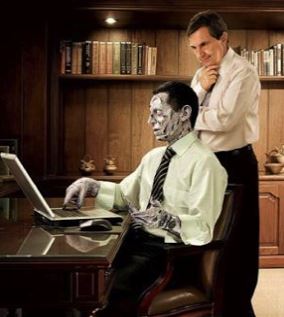 |
| Your Soul: not included in the modern economic model |
Then, when we addressed social problems by making their consideration and study fashionable, the zombie became Guilt. Because by that time, there were too many of us doing too much at once. Our sins were no longer simple.
We had so many new fears. Freddy was the fear of bad men and little girls. Ash was the fear of your cowardice in the face of your fucking cowardice, because you have unaddressed insecurities, you coward. Predator was Time coming for you, slowed not an iota by all your education and technology and good grammar and healthy diet. They were all you, all along. And you worked through them and eventually forgot about them.
 |
| Now thay're just cute. |
But things have changed. Now, you seem to be a zombie. Why? Because everybody's a zombie. I'm a zombie. Look at me, starting a blog. What are my expectations? Why do I write? Do I create art or consume bandwidth? It's terrifying. Not knowing is always terrifying. Now not staying dead has eclipsed the actual fear of death.
If we must be afraid of concept zombies, then at least we have the consolation of knowing that our fears have become sophisticated. Socially acceptable. Even fashionable. Zombies give us the power to become fearsome brutes again, (in a fairly clean, recognizable, and attractive way,) despite our framed degrees and clean shoes and manicure appointments at three. I don't mind this concept. If I have to be a menace in the end, then let me at least return to my bestial roots and be frightful like our brutish prehuman ancesters, to take on in death the dignity of an apex predator despite my spoon-fed life of powdered chicken soup.
 |
| Just like the noble cave dwellers once rehydrated. source |
But time leaves savage nobility in the dust again and again. If I am to believe Time Magazine's Joel Stein and several others, then I am of a particularly feckless and narcissistic recent generation known as millennials. I shun work and worry constantly over minute and nonexistent ailments. Narcissism is my defining characteristic. I create most of my own problems by purchasing overpriced organic food and avoiding exercise. What a bitch am I. Lowly, lowly, sadness, woe. My shame is complete, or something.
Granted, he ends the piece by talking about how millennials are digitally savvy and highly creative and some other made-up arbitrary stuff, but since I'm making stuff up myself right now, I'm not about to blame him for that. Also, plenty of better writers have had smarter stuff to say about Stein's irritating cover story since then. Still, the jibe stings. It makes me feel like biting something.
How I relish the day I join the ravenous twenty-something hordes in assailing the headquarters of Time Magazine. Cold, hard data, my ass. Give me Stein's soft brains any day. I need not work out to be a good zombie. I don't even need a place to live after my undeath - my parents probably wouldn't have me anyway, but more to the point, my landlord would probably try to kill me. Anyway, an apartment is no place for a free-range zombie. And a job? A job? Excuse me, but I didn't go through the entire reanimation process to spend my precious time working instead of spending my time running down the brains that I love. Occupy Zombies!
 |
| www.dailymail.co.uk |
To put it briefly, millennials love zombies because we are so darn tired of hearing about what lazy assholes we are. Some of us go to fairly exhausting lengths to untooth that stereotype, which of course makes us want to give it bigger fangs. We want what we can't have, et cetera.
Because aren't zombies the perfect despicable young people? To live the terrifying dream as a piece of ultimate resilient networked swarm intelligence, I need not read up on leadership or human resources or C++. There's no reason to put in a few years of time at a job I hate. Zombiehood is monsterdom without all that tedious preparation. It is a release of personal responsibility, a simple, focused, 100% effective pattern ad infinitum, a part in a single whole that is more successful than a plethora of individual human beings over all of human history reliably failing to work together for any reason. It's OK to be obsessed with eating and making more of myself when I am dead. That's the point of being a zombie.
Zombies are better functional humans than the excitable monkeys that go around digging up minerals and pumping weird gasses into the air. The monkeys create stuff and then can't figure out what to do with it. The zombies just consume. They kind of clean up the place, actually. Their only joy is the act of communion turned creation, sex and eating and social sauce all in the same action. They are joyful, these zombies. They've found the magical item we're all looking for on Black Friday: the One Thing That Will Make Us All Happy.
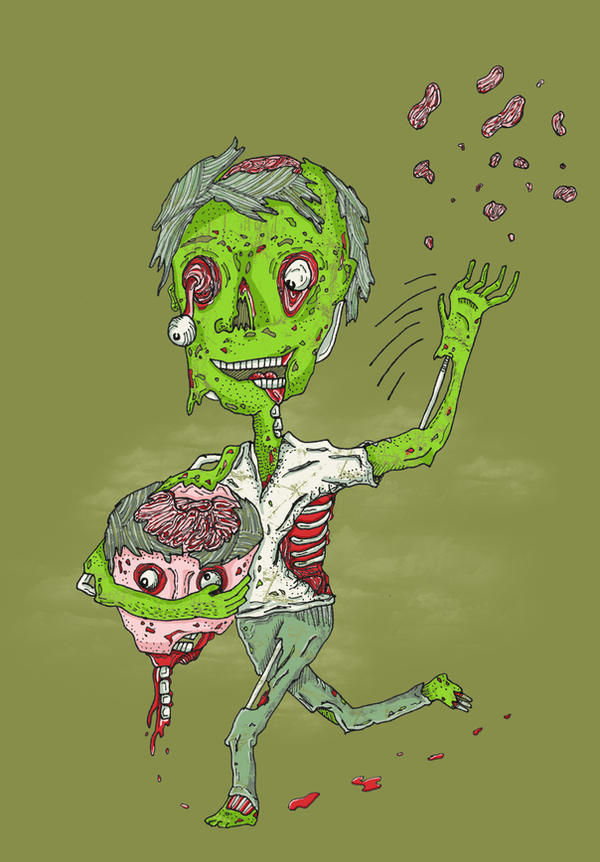 |
| by the brilliant randyotter |
This is why we must defeat zombies again and again in videogames, movies, in ourselves. Zombies are just better. Zombies are already here. The zombie inside us has already won. We just don't know it yet. Think of a way to make yourself better than a zombie - any way at all, really - and you're winning.
Subscribe to:
Posts (Atom)